Indigo Edina, Provisional Spokesperson for Northwest England
My name is Indigo, and I, as well as being your Provisional Chair, am also the LLA’s regional representative for the North West of England. I spent my whole childhood growing up in the North West of England, and it is therefore a region of the country I care deeply about. Its big, forward looking cities have hosted much of Britain’s left libertarian thought for centuries, providing a legacy I hope to participate in.
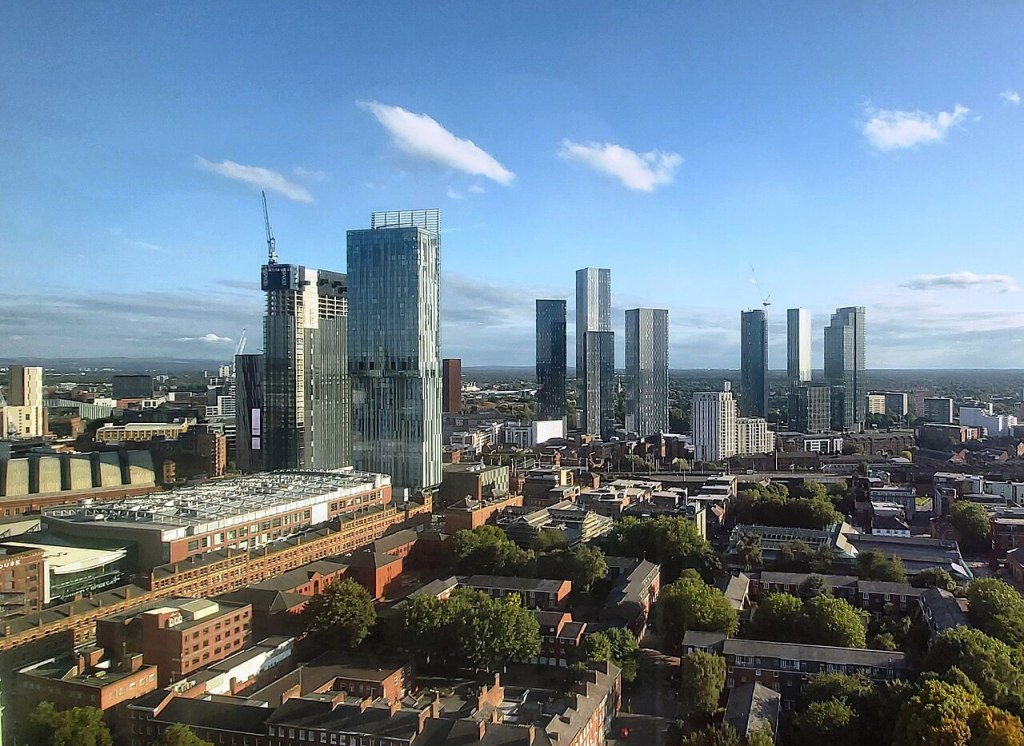
One of these regions, Greater Manchester, has seen a change in leadership with the ascendancy of former mayor Andy Burnham to No. 10. While having more immediate implications on policy areas such as housing and regeneration, the election has affected the prospects of a proposal to test the viability of one of the most radical welfare changes: universal basic income.
Back in February 2025, academics at Northumbria University and campaigners from the UBI Lab Network first proposed a basic income pilot targeted at people from disadvantaged backgrounds. Selecting 100 to 200 young people at risk of homelessness, the pilot would give each participant £1,600 per month for two years. A similar pilot conducted by the Welsh Government directed at young people leaving care saw participants report greater wellbeing, autonomy, and opportunities as a result of the basic income payments they received from 2022-24. Sam Gregory of the UBI Lab Network thus argues that such a policy could, “fundamentally rebalance economic power towards ordinary people.”
A change in leadership in Greater Manchester, with Labour Co-op candidate Bev Craig winning the region’s mayoral by-election in July, also changes the prospects for this pilot. Where previous mayor Andy Burnham has expressed interest in universal basic income as a potential answer to poverty and homelessness, Craig has made no similar commitment. Of the seven candidates, only Green candidate Geraldine Coggins committed to financially backing the pilot as mayor. The scheme’s future under the new administration is, thus, less clear in terms of receiving the necessary funding.
If this pilot goes ahead, the longer-term impacts will reach much further than the hundreds of participants. If universal basic income proves viable on the grounds of both human flourishing and cost-effectiveness, we very well could see the adoption of this kind of welfare provision in place of the means-tested benefits the UK has at present. Where other welfare provisions trap people by pulling the rug of support out from beneath them the moment their condition improves, UBI creates a floor to poverty. Unconditionality also allows the system to operate without being administered by a bloated and demeaning bureaucracy, whose expenses can instead be directed towards helping people. In addition, the ability of recipients to spend the money how they wish promotes autonomy, which reports on the Welsh pilot also noted.
These would not just be abstract gains, but tangible relief for the North West of England. A region where 23% of the population lives in poverty, unconditional basic income payments would make a real difference for many. If the pilot delivers for Manchester, I hope to see its scope expand to the rest of the North West region, a part of the country hit hard by post-industrialisation and the Global shift. Areas such as Blackpool, Morecambe, Blackburn, and Barrow-in-Furness contain some of the most deprived wards in the country, and would be the areas to benefit the most from the implementation of a basic income.
On this basis, it should be no surprise that UBI is often supported by the libertarian left. The appeal of unconditional and debureaucratised welfare is alluring to those of us who seek to tackle inequality without enlarging the state. Such a proposal has remained popular amongst left libertarians throughout history; Henry George spoke of giving back to communities in what he called a citizen’s dividend, while the cause of UBI has been taken up more recently by theorists such as Philippe Van Parijs. The Left Libertarian Alliance shares the values behind this pursuit, and thus the drive to deliver justice for regions like mine.
 Left Libertarian Alliance
Leave a comment