Mor Tavares (Blog Co-Editor & Spokesperson for the Midlands)
Mor Tavares is currently completing their PGCE after having studied at the University of Oxford. They reside in the West Midlands and are therefore the LLA’s provisional Midlands Spokesperson. They also act as one of the two blog editors for the LLA.
Recently I visited a friend in Wolverhampton. She was genuinely surprised that I was willing to do so; she is hardly proud of her city of origin. I am not so either: I hail from Rugby, the approximate centre of England, and yet a cultural dead zone. However, Wolverhampton changed my approach to my hometown. My hometown may have history to recommend it – the radio tower by which the BBC set its clocks, the sport of rugby football, the poetry of Rupert Brooke – but now it is a long string of buffet restaurants strewn with AI advertisements, charity shops, vape shops and knockoff KFCs. The saving grace of a few rather interesting restaurants (thank you, Boriswave) and the sort of café with the interior design of a bored deano housewife is welcomed with open arms. Yet Wolverhampton has very little of this, and instead, weapons disposal bins, which I had not seen before my visit.
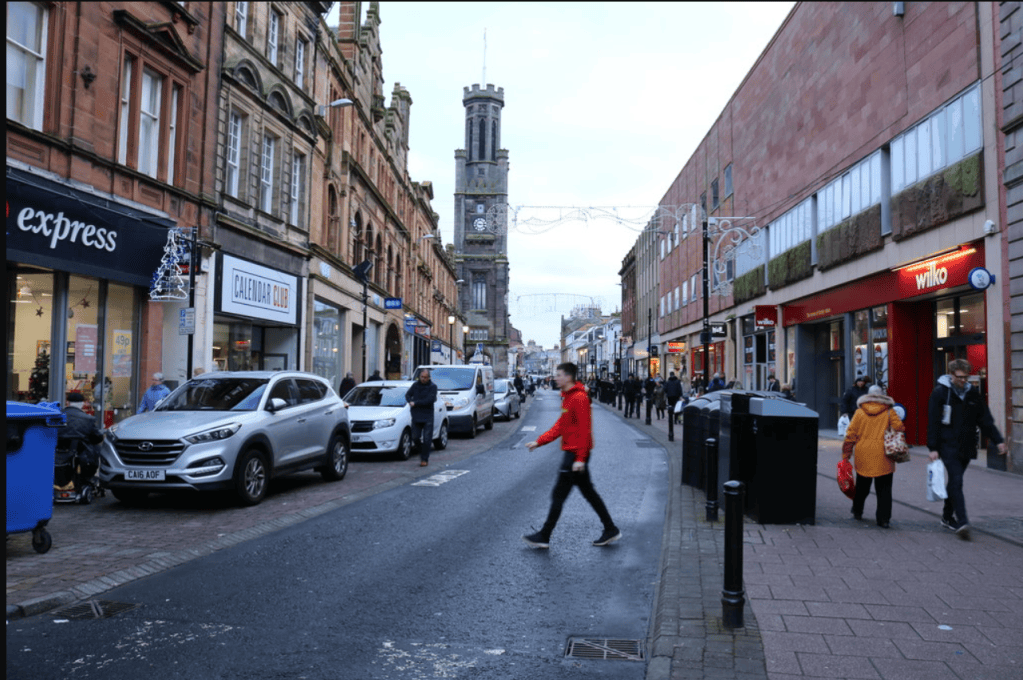
Fortunately, Andy Burnham is on the case: he has made it clear that he wants to change how high streets look by granting more powers to local councils to refuse and scrutinise vape and betting shops. Yet to treat these as a “visible sign of decline”, as No. 10 does according to the above Guardian article, we ought to consider why vape shops and betting shops are regarded as a sign of our high street’s downfall. Health Equity North has claimed that vape shops are more frequently found in deprived areas. I can attest to this: Cowley, an area within the bounds of Oxford City Council, has a higher level of deprivation than the city itself, and is resplendent with vape shops. Is it possible that when those in political discourse say “decline”, they mean, “it makes our area look poor”? Is that just and right?
Even in Oxford city centre, the high street is strewn with tourist shops, which makes the city centre less attractive and more, well, tacky. There has been enough anguish about these shops to cause the council to publish a reel on Instagram which explains that they have limited power over what kind of shops operate in their city centre. Even though Oxford is still a pleasant city whose high streets do possess independent coffee shops and restaurants, the legislative changes Burnham wishes to introduce may change how the council responds to, and considers, local residents’ obvious disdain for tourist shops. The approach that the government is taking is one of considering the high street to be a space held in common by all residents of an area, and therefore handing power to councils is a form of democratising the space.
As libertarians on the left, we ought to put Burnham’s proposals to the test by asking, firstly, if the implied version of “better” is something we wish to legitimise, and secondly, if government power is the correct tool for making our high streets look “better”. Then, if we find the contrary on any count, we ought to define a more cogent means of beautifying our town centres. As such, I return to the possibility that “better” in this sense is defined on classist and also racist premises.
The disdain for vape shops can equally be applied to Turkish barbers: the BBC reports on Kurdish barbershop owners involved in gang activity, and the Financial Times claims that our high street is being ‘taken over’ by these barbershops. The concern about appearing low-class is tied to an implicit concern with appearing foreign, and the wrong kind of foreign. Anyone well-versed in basic intersectional thought has had this idea, mind. The Financial Times article makes this case: it compares the contemporary Turkish barber shop, a skin-fade factory, with its glorious ancestor, the Ottoman barber. The modern-day equivalent is framed as decadent, a kind of low-class fake wealth. The concerns of people bemoaning vape shops often apply to Turkish barbers too – indeed, they are often lumped together by the media.
Let me pose a question, though. Without assuming that the answer will lead you to be judged as a latent racist or classist, would you prefer to live somewhere lined with Turkish barbers, vape shops, charity shops, and empty store fronts; or somewhere with a Gail’s on one corner, a florist’s on the other, two pubs and a Sainsbury’s Local? I would not be entirely surprised, and I do not blame you, if you stated the latter. I would too; as the aforementioned Wulfrunian friend of mine once stated, exasperatedly, “Why wouldn’t you want gentrification? It just makes everything nicer.”
Our problem is therefore that disdain for Turkish barbers, vape shops and betting shops can be disdain for your area looking impoverished. It can also be disdain for migrants making themselves successful in your town. If we target businesses with no plan for how to uplift a town centre, including all of its residents and local businesspeople, we are simply doing something which closes shops because they, stereotypically, are owned by migrants. Vape shops happen to exist in more economically deprived areas because that is where the empty storefronts are and can therefore be bought up. What must be made clear in Burnham’s plans is that his priority is not just on making towns aesthetically pleasing, but on actually filling storefronts everywhere with shops which satisfy the needs and interests of a local community.
Georg, our other blog editor, has made a wonderful case for cooperatives. I am biased, having edited their work, but it is truly smashing. Cooperatives provide one very admirable model to uplift a local area’s economy; members of a local community pooling resources and their democratic will to deliver, say, a grocery store which delivers what they desire will naturally be more beneficial than just being at the whim of, say, Sainsbury’s. If the government wishes to intervene in how our high streets look, taking an interest in co-operative startups by giving them a loan with low interest, or even a grant, would be a huge step towards putting power over the high streets back into the hands of those who live there. Pooling so much of a community’s resources would also allow these groups to outbid businesspeople preying on the economic fragility of a town or city.
The further benefit to cooperatives on the high street is that they democratise further than councils can. Councils, to a certain extent, must keep in mind that any time they permit a lease to a business, it must ask whether this business will bring money back to them. People are addicted to tobacco, people want haircuts, and people want cheap clothes. Vape shops, Turkish barbers, and charity shops will tend to deliver some money for the council, or at the very least keep an open storefront and keep the town centre from looking like an abandoned ghost town. Cooperatives can deliver on profits because they will be able to provide ethical products without the usual markup, as they have the backing of the community surrounding it. They add a layer of democracy to whatever the local government decides for a disused storefront by virtue of being cooperatives. Cooperatives, furthermore, with regular contributions from the community in the form of local democracy, can also determine what will, overall, lead to long-term flourishing of the community and its interests, which is a more secure business model than looking for the most immediate way to make a quick buck. Cooperatives can last, maintaining open storefronts on our high streets for longer.
Councils, however, also tend to do quite ineffectual, gimmicky things to draw businesses to their area. Rugby still has banners up around a retail park to the north of the town, praising the town for its various virtues, and inevitably mentioning the founding of rugby football. Businesses, though, want deeds, not words. What businesses really want assurance of is that there is the right sort of customer (with the right amount of money) to support their business in the local area. Rugby does not have a Waterstone’s for this reason; to be able to spend £12 to £25 on a book regularly and the ability to browse are a great privileges which are unaffordable to many. Stocking a large History or Classics section does not make sense in a town has lower qualifications on average than nearby Warwick, and fewer people to sell books to than the nearest city. In order to aestheticise the town centre, one must ensure that people have the cultural capital to want better for themselves, and the money to have better for themselves.
Largely, the government’s grants tend to be for research, action to combat climate change, or youth employment. None of these would apply to a small business owner who wants to start a vegetarian café with evening cookery classes, for example, unless they were to nearly exclusively employ young people. The government needs to hand more money-raising powers to local government (perhaps through a Land Value Tax…) to create the conditions for local small businesses to be funded properly and to fill some empty storefronts with businesses which shall serve the local community.
The issue with government intervention, as implied, is that judgement over what is an “acceptable” business to appear on the high street is not always made on the basis of benefit to the local community. It is made on the basis of what is aesthetically appealing and profitable, which will likely have underlying biases around the implied ethnic background of business-owners and around the class of the implied customer base too. One way of combating this issue is with cooperatives, as mentioned, but another is simply local, grassroots campaigns. There has been an outpouring of support in Oxford for the Ultimate Picture Palace; similar campaigns are possible up and down the country for restaurants, grocers, and markets.
Equally, as some variant of a libertarian, I naturally believe that a free market can have its benefits. However, the best variants of a free market require people to know what they are doing and to have the money to do so. If and when people in an area have enough money (which requires many broader government initiatives which would depart from the point of this article), they can easily put their money where their mouth is. If they do not like there being a vape shop in their area, they can stop using it. Maybe they will start buying cigarettes instead. Maybe, also, if a population is given enough opportunity through their education, they will also gain the cultural and theoretical capital to have a deeper relationship with what they buy and consume. With more money in their pocket too, consumers can make an area an ideal location for a business to put down roots. Bring on the M&S!
Andy Burnham’s proposals for cleaning up our high street are admirable in their drive to hand some power back to local communities. What is lacking is the broader impetus to uplift whole local populations and give them the fiscal backing to allow them to collaboratively and wisely shape the kinds of high streets they truly want to see. As it stands, the proposals risk closing or refusing shops on racist, classist grounds. We must work together to phase out vape shops, not cull them and leave storefronts empty.
 Left Libertarian Alliance
Leave a comment