Indigo Edina (Chair & Spokesperson for North West England)
In advocating for left libertarianism, one becomes accustomed to juggling various different traditions of political thought at once and trying to make the outcome a coherent whole. Often, this is not nearly as difficult as it seems; given the historical connectivity of liberal and leftist thought, their ideas often stem from the same body of theory. In such cases, articulating the left libertarian position is analogous to a well-attended and thoroughly enjoyed family reunion. But what happens when this otherwise wholesome get-together is put on hold by a seemingly irreconcilable dispute?
One such instance pertains to the environment, where leftist and libertarian thought are perceived as polar opposites on the political spectrum. The New Left has gained the reputation as the champions of environmentalism and sustainability, with these activists founding many of the Green parties which emerged across Western nations during the latter 20th Century. For this movement, people and planet go hand in hand, especially in the face of anthropogenic climate change. As a member of the Green Party of England and Wales, I share this impulse.
However, the libertarian component of my political intuitions compromises my ability to endorse state-led environmental initiatives. With the understanding that state-backed mandates are contrary to individual rights, environmental politics loses a lot of its punch. In order to address this tension, it is necessary to centre environmentalism in the very foundations of libertarian theory. The purpose of this article is thus to offer one such way to build a libertarian environmental politics, doing so from a Lockean perspective.
I: Greening the Lockean Proviso
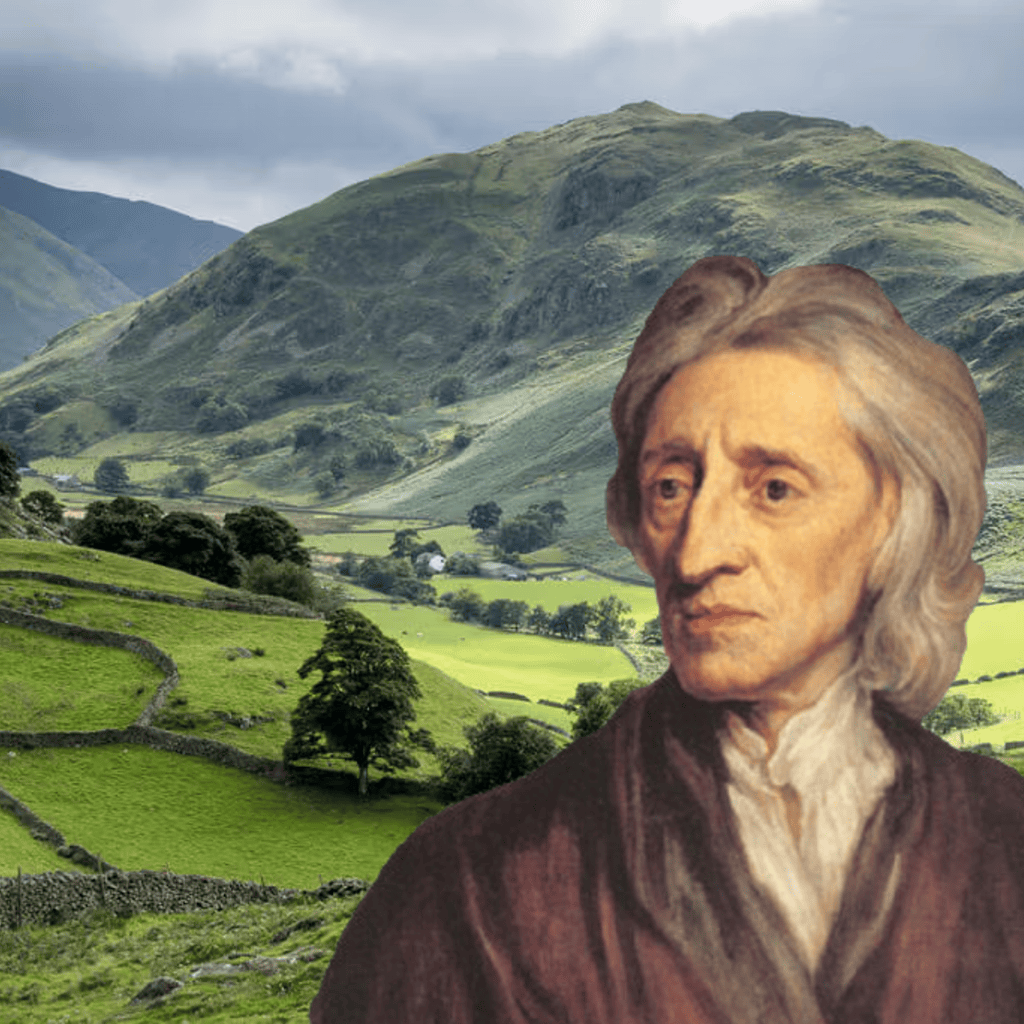
As with much of modern political theory, whether libertarian or otherwise, we can trace the genesis of this debate back to John Locke’s Second Treatise on Government. Here, Locke adopts the framework of property rights and natural resource egalitarianism which has informed left libertarian thought ever since:
“Though the earth, and all inferior creatures, be common to all men, yet every man has a property in his own person: this no body has any right to but himself. … Whatsoever then he removes out of the state that nature hath provided, and left it in, he hath mixed his labour with, and joined to it something that is his own, and thereby makes it his property. … for this labour being the unquestionable property of the labourer, no man but he can have a right to what that is once joined to, at least where there is enough, and as good, left in common for others.”
In short, the natural world is the common inheritance of all mankind, but can be taken into private ownership by mixing one’s own labour with the land. This is subject to what Robert Nozick dubbed the Lockean proviso, that there must be, “enough, and as good, left in common for others,” once all is said and done. For the bounty of nature to be equitably distributed among society, this arrangement is highly merited. Alas, this framework has a critical failure: it neglects to consider that our species is not the only one with an interest in ownership and regulation of the natural world.
It is now widely accepted that humanity is not above nature, but itself a part of the intricate web of relations between species that comprises Earth’s biosphere. Non-human animals may exist outside of human society, but are agents in their own right; agents with legitimate interests which often complement our own. The Lockean framing of these species as “beasts” and “inferior creatures” thus becomes untenable, especially among opponents of hierarchy on the libertarian left. Animals do not exist merely as resources to be exploited by man, but as living sentient creatures in their own right. The natural world must therefore be party to the Lockean proviso, lest the whole arrangement be rendered illegitimate on the basis of its arbitrary distinction between Earth’s various inhabitants.
We are therefore able to grant nature rights without violating libertarian self-ownership by making the whole biosphere party to social arrangements pertaining to it. This justification only works for libertarians of the Lockean tradition; the Rothbardian commitment to homesteading lacks an obvious mechanism for the rights of nature to be respected. In turn, various forms of communist anarchism have their own ecological framework devoid of a property rights framing. The discussion that follows shall therefore be focussed on libertarians who broadly fall under the Lockean-Nozickian umbrella, including the left libertarianism of Hillel Steiner and Peter Vallentyne.
II: Shallow and Deep Ecological Interpretations
Resolving to leave “enough, and as good” to nature when appropriating natural resources is one thing. But what does this actually mean for our relationship with the natural world? Just as there are different interpretations of the Lockean proviso, this section shall be dedicated to considering what variations on an ecological proviso would look like. Much of this variation lies along the distinction drawn by Arne Næss between shallow and deep ecology. The former is primarily concerned with pollution and resource depletion, centring nature only insofar as it impacts human society. The latter commits itself to a more comprehensive overhaul of how we relate to nature in the direction of biospherical egalitarianism.
A shallow ecological proviso would make nature party to relevant social arrangements, but not as an equal partner. Under this system, there is an obligation to preserve ecosystems when zoning through means such as the creation of green belts and nature reserves. Protections on endangered species would be in place, ensuring that no animals are driven to extinction by our actions. Pollution is limited to certain geographic areas, or levels by which no major risk is posed to local biota. Carbon emissions are either prohibited or subject to a penalty. Many of these proposals, such as regulations on pollution or carbon taxes, are already justified by some libertarians on the basis that they uphold individual rights. A shallow green proviso thus consolidates this into a protection extending to wildlife as well.
A deep ecological proviso, on the other hand, would ensure a fully egalitarian footing between man and the rest of Earth’s lifeforms. Viewing the delineation of human and natural areas as insufficient, the deep green proviso deems environmental consideration necessary for any human development to be compatible with the rights of nature. Beyond mere zoning, measures to ensure that all new builds do not reduce biodiversity would be in place. Pollution and emissions of all kinds would be set at the bare minimum for human need, which would entail a shift towards plant-based diets and reduced consumption of energy where possible. In lieu of historical environment injustice, the deep green proviso would also justify mandates regarding the active effort to rewild degraded areas and reintroduce species rendered locally extinct in the past. This offers a far more radical and comprehensive vision of what libertarian ecology may look like, stemming from a truly egalitarian arrangement between all species which call this planet home.
On the question of whether or not these constraints on human behaviour are libertarian, one must remember that the Lockean-Nozickian tradition is more so a theory of entitlements than an endorsement of unencumbered activity. An individual’s ability to do certain things can be constrained under libertarianism, so long as such limits are only in the service of guaranteeing entitlements. The unlimited appropriation of natural resources is already prohibited on the basis of its violation of individual rights, so why not apply the same principle to the rights of nature? If we agree to grant non-human animals basic self-ownership rights, as Peter Vallentyne suggests, then their entitlement to their own bodies trumps the human desire to consume meat. Plus, Nozick’s recognition that reparations may be legitimate to address past illegitimate transfers of property opens the door for a justification for rewilding and other restorative ecological practices. In recognising that nature has its own entitlements, we therefore expand rather than overturn libertarian political theory.
Nor does the distinction between shallow and deep libertarian ecology have to be a strict binary. A number of provisos exist between either position, adopting some elements of both. I myself am drawn to something of a middle position, where consideration of biodiversity and past injustice are at the forefront of all human developments, but not to the extent where degrowth becomes mandatory. Correcting for environmental degradation by forcefully reducing the human standard of living merely replaces one injustice with another. Biodiversity neutrality and mutually beneficial rewilding are all reasonable asks. But in cases where the cost-benefit analysis does satisfy nature’s stake, no further action should be necessary. The Sheephouse Wood bat protection structure comes to mind; given the conservation status of Bechstein’s bat as ‘least concern’ in Britain, spending in excess of £100 million on a half mile bat tunnel ought not to be an obligation. There is clearly “enough, and as good” woodlands in the South of England for bat roosting with HS2 as there is without it, with the 20.6 hectares of ancient woodland lost to its construction being made up for by the decreased need for the long-distance car journeys which have comprised much of Britain’s carbon footprint for decades.
III: Left Libertarian Ecology
We libertarians really ought to reconsider the way we interact with the natural world. Having moved on from the Lockean position that nature exists for us to exploit and colonise, the status of our fellow biota ought to be granted its rightful place in our philosophy. An ecological proviso does precisely this by recognising non-human animals as co-inhabitants of the world we all own in common. While compatible with libertarian frameworks derived from a Lockean theory of property rights, this approach finds particular resonance on the libertarian left. If we commit ourselves to the abolition of hierarchy and the equitable distribution of the Earth’s wealth, the next logical step is to topple to pedestal we have placed ourselves atop and regard the other life on this planet with more dignity and respect. The focus on dismantling hierarchy and ensuring rights for all logically extends to the natural world, after all.
People over planet is the old way.
Planet over people is the wrong way.
People and planet is the way towards justice.


Leave a comment